How did Stryv turn a hairdryerinto a regional self-care brand?
It started with one personal-care product, then used creator-led demand, direct sales, and physical retail to make affordable luxury feel local.
The Trust-at-Home Loop
Stryv did not sell beauty as distant luxury. It sold daily confidence as something ordinary people could try, afford, and repeat at home.
The sharper move was not simply making a cheaper hairdryer. Stryv identified a repeated emotional moment: people look at themselves before they face the world. By building around affordable premium tools, Asian routines, creator content, and mall-based demos, the brand turned a functional appliance into a habit-forming confidence product.
The founder's journey
How Stryv found the growth channel
Roy Ang starts with livestream software
Before Stryv, Roy Ang and Ming Hao Teoh built a livestream commerce software business. It reached meaningful GMV quickly, but the take rate was too thin for the kind of durable company they wanted.
Evo Commerce pivots into D2C
The founders saw livestream sellers keeping more economics by selling their own products. That pushed Evo Commerce toward direct-to-consumer brands, beginning with wellness brand BounceBack, later renamed bback.
A postpartum gift becomes the first Stryv wedge
After seeing how a quality hairdryer lifted his wife’s confidence after childbirth, Roy spotted a product gap: premium haircare tools existed, but many were priced out of reach for everyday buyers.
Stryv launches as a digital-first brand
Stryv entered with a direct-sales model, working with experienced manufacturers while using local creators and online channels to make the brand feel familiar rather than imported.
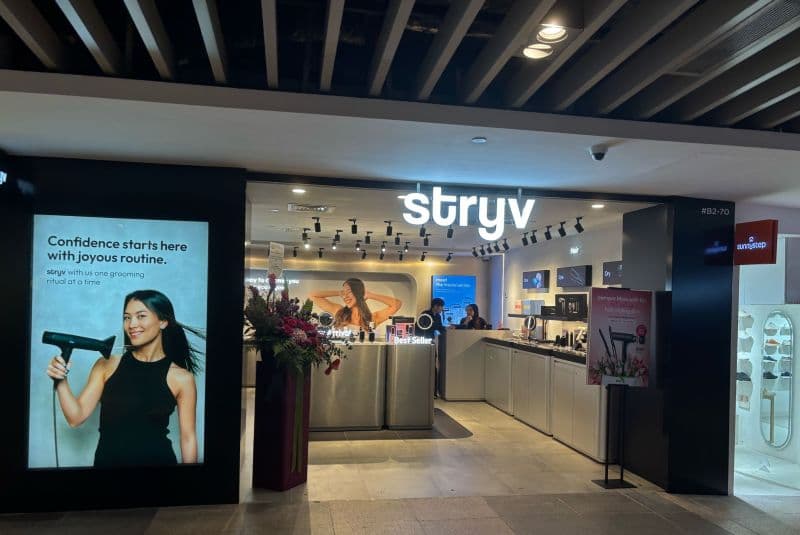
The first physical store opens at Suntec City
Once online demand stabilised, Stryv moved offline. The store let customers try products in person and turned consultants into the human version of a high-converting product page.
Stryv scales across malls and markets
Reports describe Stryv expanding into multiple Singapore outlets and regional markets including Malaysia, Hong Kong and Taiwan, while broadening from hairdryers into stylers, shavers, oral care and other personal-care tools.
The product loop
How Stryv compounds demand
Spot a daily confidence problem
Hair, grooming and self-care are repeated routines, not one-off purchases.
Build an affordable premium product
Use strong manufacturing partners and direct sales to avoid middleman-heavy pricing.
Make the product feel local online
Creators, social content and Asian-use cases make the brand relatable.
Let shoppers try before buying offline
Mall stores turn trust, texture and demos into conversion.
Expand into adjacent routines
Satisfied customers can buy the next tool in the same self-care system.
- ↻ Spot a daily confidence problem
- D2C LOOP
Stryv’s loop links online discovery, direct margins, in-store proof, and adjacent personal-care categories.
The competitive map
Where Stryv competes
Stryv sits between global premium appliance brands, mass retail personal-care tools, salon services, and creator-native beauty brands.
Dyson
High-end engineering-led haircare appliances with strong global brand trust
↳ Aspirational, but often priced far above mass-market comfort
Stryv
Affordable premium self-care tools designed around Asian routines and sold through both online and offline channels
↳ Makes premium grooming feel local, attainable and demo-friendly
Mass retail brands
Accessible grooming tools sold through pharmacies and electronics retailers
↳ Easy to buy, but less emotionally differentiated as a brand
Salon services
Professional results delivered by stylists instead of at-home tools
↳ High trust for special occasions, but weaker for everyday repeatability at home
Low-cost utility <-> Premium self-care →
Founder mode
Founder mode: learn the channel before scaling it
Roy Ang’s pattern across Stryv is unusually practical: find the margin structure, prove the first product, then learn the next channel deliberately. Before opening stores, he reportedly spoke with around 30 retail founders and studied retail operations intensively. That matters because offline retail is not just online commerce with rent. The staff, demo, mall choice, inventory and training become the product experience.
Evo Commerce
Parent company
Roy Ang
Co-founder and CEO
Suntec City
First flagship store
Lessons for builders
What ambitious founders should steal from this playbook.
Lesson 01
Start with an emotional job, not a product category
Stryv’s first wedge was not simply hairdryers. It was confidence before leaving the house. That made the product easier to position, expand and remember.
Consumer brand foundersLesson 02
A failed model can still reveal the next model
The livestream software business exposed the economics of creators and direct selling. The important move was carrying the learning forward instead of defending the original idea.
Founders considering a pivotLesson 03
Offline retail can be a conversion tool
For tactile products, a store is not only a sales channel. It lets customers feel weight, airflow, finish, noise and trust in ways a landing page cannot fully communicate.
D2C and hardware startupsThe NBT take
If customers need to feel the difference, build the channel where they can feel it.
— The NBT interpretation
Stryv is a reminder that consumer brands are not built only by looking premium. They are built by owning a routine. The brand found a repeatable moment, priced it within reach, spread it through creator-led familiarity, then made it tangible through stores. For young founders, the lesson is simple: the best product category is often the one where people already care deeply, repeat often, and feel underserved by existing prices or positioning.
Sources
- About us — Stryv
- Stryv official store — Stryv
- How personal care brand Stryv bounced back from almost failing to opening 8 outlets in S'pore — Vulcan Post
- From Online To Offline: How Roy Ang Plans To Scale Stryv Into A Billion-Dollar Brand — DollarsAndSense
- Stryv brand page — Watsons Singapore
- Stryv store listing — CapitaLand Malls
Written by Javier Cheng with help from NBT'S Mosaic on 24 Aug 2026.