How did TreeDots turn unwanted foodinto a supply chain?
One buyer’s waste is another buyer’s inventory.
Match the Mismatch
A supermarket might reject a chicken because it is too large or has a broken bone. A restaurant may not care — it will cut, cook and plate the chicken before the customer ever sees it.
TreeDots realised that some food becomes “waste” not because it is unusable, but because the wrong supply is matched with the wrong buyer.
Its marketplace connects suppliers holding surplus or imperfect food with businesses willing to buy it at lower prices. Suppliers recover value from inventory that might otherwise be discarded, while buyers get usable ingredients more cheaply.
The breakthrough was not convincing people to care more about waste. It was making waste economically irrational.
The founder's journey
Key milestones
The Avocado Problem
The idea behind TreeDots emerges after co-founder Nicholas Lim encounters a shipment of Mexican avocados that cannot reach its intended market. He helps redirect it to willing buyers in the Philippines, revealing how usable food can become waste when supply and demand fail to meet.
TreeDots Begins
Tylor Jong, Lau Jia Cai and Nicholas Lim start TreeDots to tackle inefficiencies in the food supply chain. TreeDots’ own chronology and TechCrunch describe the business as beginning in 2017.
A Marketplace for Rejected Food
TreeDots builds a B2B marketplace connecting suppliers holding surplus or imperfect inventory with F&B businesses that can still use it. Restaurants may care less about cosmetic imperfections because ingredients are transformed before reaching diners.
Malaysia
TreeDots expands into Malaysia, taking its food-supply-chain model beyond Singapore.
Beyond Surplus Food
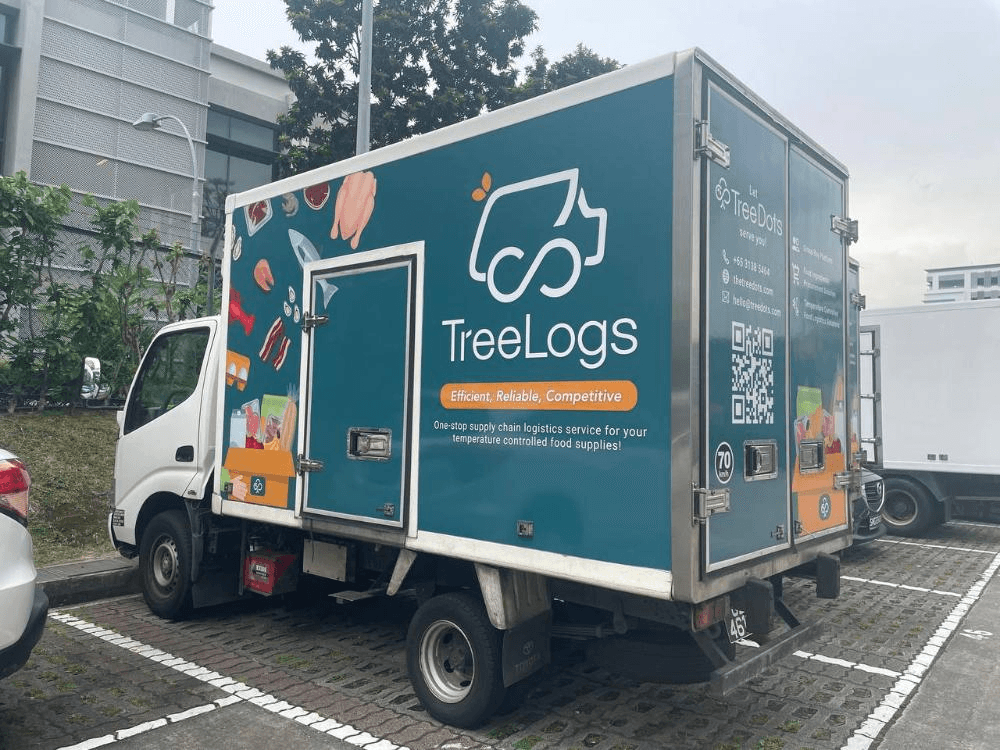
TreeDots develops social-commerce group buying for consumers and TreeLogs, its cold-chain logistics operation, evolving from a surplus-food marketplace into broader food-supply-chain infrastructure.
US$11M Series A
TreeDots raises US$11 million in an oversubscribed Series A co-led by East Ventures and Amasia, bringing total funding at the time to approximately US$15 million.
The product loop
The Density Flywheel
More Suppliers
More Aggregated Food Volume
More Buyer Demand
Denser Deliveries
Better Logistics Economics
More Attractive Distribution
- ↻ More Suppliers
- AGGREGATION + DENSITY ECONOMIES
TreeDots discovered that aggregating supply could improve more than food utilisation. By combining orders and supply across multiple suppliers, several deliveries can share the same logistics network. Greater network density can reduce logistics costs and emissions while making the platform more useful to suppliers and buyers.
Surplus marketplace → aggregated demand → denser logistics → broader distribution infrastructure
The competitive map
The competitive map
TreeDots sits at the intersection of sustainability and commercial food distribution: using surplus-food matching as an entry point into marketplace, distribution and logistics infrastructure.
Surplus Marketplace
Matches unwanted inventory
↳ Alternative buyers for usable food
TreeDots
Surplus matching → commercial distribution
↳ Marketplace, distribution and logistics infrastructure
Food Donation
Redistributes usable food
↳ Primarily organised around social impact
Traditional Distributor
Moves regular food inventory
↳ Established wholesale channels
Food Rescue ←→ Commercial Distribution →
Lessons for builders
What ambitious founders should steal from this playbook.
Lesson 01
Find Value in Someone Else’s Constraint
A product rejected by one customer is not necessarily worthless. TreeDots realised supermarkets and restaurants have different requirements. The same chicken can be unsuitable for a supermarket shelf but useful in a restaurant kitchen. Before changing the product, ask whether you can change the buyer.
Marketplace foundersLesson 02
Make Impact the Economic Choice
TreeDots does not need buyers to purchase surplus food purely out of environmental concern. Buyers can save money while suppliers recover revenue from inventory that might otherwise be discarded. The strongest impact businesses make the sustainable decision economically attractive even without altruism.
Impact foundersLesson 03
Follow the Problem Upstream
TreeDots started with food waste. But suppliers eventually began using its system for more than surplus inventory. That revealed a larger opportunity: inefficiency across food distribution itself. Your first problem can be a doorway into a much bigger one.
Early-stage foundersThe NBT Take
TreeDots began with food that nobody wanted.
But the food itself was often not the problem.
A chicken that looks wrong on a supermarket shelf can work perfectly well in a restaurant kitchen. A shipment stranded in one market may have willing buyers somewhere else. What looks like waste can actually be a failure to match supply with the right demand.
TreeDots built a business around fixing that mismatch.
Then came the more interesting discovery. Suppliers began using its system not only for unwanted food, but for regular inventory too. The waste problem had exposed something larger: inefficiencies in food distribution itself.
That pushed TreeDots beyond a surplus marketplace and toward logistics and supply-chain infrastructure.
Sometimes the discarded product is not the opportunity. The broken system that caused it to be discarded is.
Sources
- The TreeDots Story — TreeDots
- TreeDots gets US$11M Series A — TechCrunch
- TreeDots secures US$11M Series A — East Ventures
- TreeDots nets US$11M for its food surplus marketplace — AgFunderNews
- TreeDots food ecosystem — TreeDots
Written by Javier Cheng with help from NBT'S Mosaic on 5 Oct 2026.